
Engagement is a psychological state resulting in a positive, fulfilling, work-related state of mind that increases employee motivation and performance, customer satisfaction, and ultimately, business success.
Organizational psychologist and founding father of "employee engagement", William Kahn (1990), described engagement as a psychological state where we fully applied ourselves at work. Since then, research by academia and practitioners continue to shape our understanding of how engagement impacts employee motivation, performance and business outcomes.
At Perked!, our framework for measuring engagement and drivers of engagement is based on decades of academic research in organizational psychology coupled with the latest in data science.
In this article, we’ll introduce the Work Engagement Framework and the four questions we use to measure employee engagement. Later, we’ll talk about the difference between measuring engagement (outcome metric) and drivers of engagement (driver metric).
Work Engagement Framework
Schaufeli et al. (2001) defined engagement as a "positive, fulfilling, work-related state of mind that is characterized by vigor, dedication, and absorption".

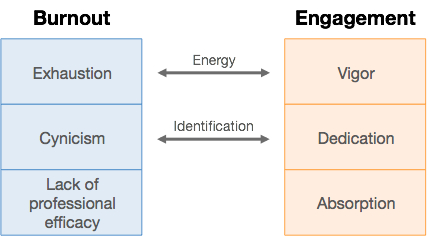
[Figure 1: The relationship between burnout and work engagement. (Schaufeli and Salanova, 2007)]
Four Questions to Measure Engagement
Based on the Work Engagement Framework, these three questions are used to measure vigor, dedication and absorption:
- Vigor: "When I get up in the morning, I am excited to work at CompanyX."
- Dedication: "I'm proud to work at CompanyX."
- Absorption: "Overall, I'm happy in my job at CompanyX."
In addition, the Employee Net Promoter Score (eNPS) is used to measure employee loyalty. Learn more about this outcome metric here.
4. Employee Net Promoter Score (eNPS): "I would recommend CompanyX as a great place to work."
All four of these questions roll up to the aggregated Engagement score giving you a comprehensive understanding of your organization’s employee engagement.